Confused Apple Trees
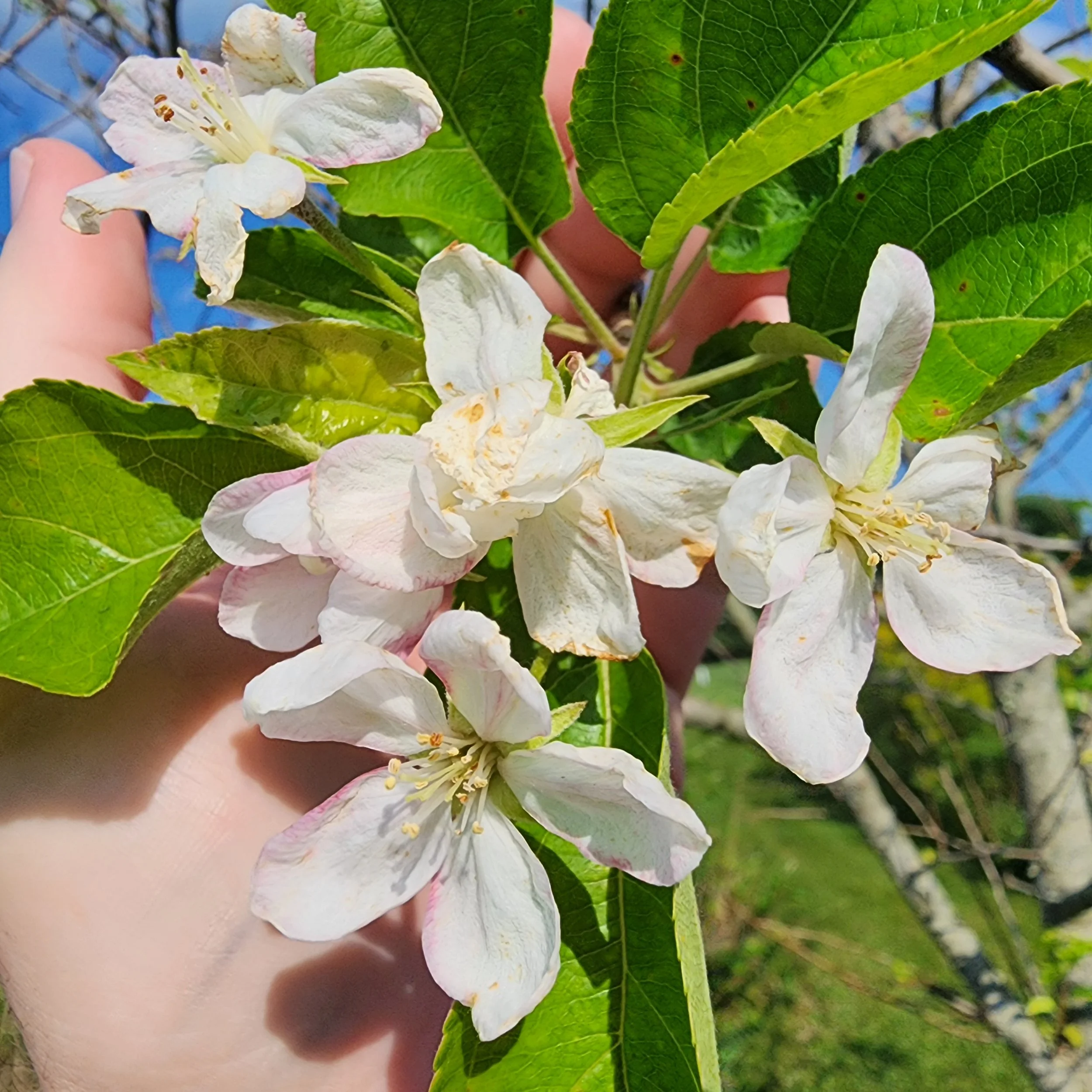
This past weekend I was mowing my lawn when something curious caught my eye. Blossoms on the lower limbs of one of my apple trees! The tree wasn’t in “full bloom”. In fact, there’s still some apples hanging on near the top. There are just some sporadic bunches of blooms here and there being enjoyed by some honeybees that were probably as confused as me. Why are my apple trees blooming in the fall?
What’s happening?
Apple trees in this region bloom in late April or early May. Those flowers become the crop we pick from August into October. Next year’s flowers are already formed by midsummer, tucked into buds along the spurs. Those buds are supposed to stay shut until they have been through winter.
Woody plants keep time with more than a calendar. Growth starts and stops with moisture, heat, and day length. When a tree is forced to shut down — heat, a dry spell, early leaf drop from disease, even a hard summer pruning — and then conditions ease, some of those next-spring flower buds can finish developing and open. Michigan State University Extension has described the same pattern for years: a pause in growth, then rain, then a handful of blossoms that belong to April.
The Mid-Ohio Valley had a hot start to September this year, with highs back in the 90s, and then, oh my, the rain returned! That stop-and-start pattern is exactly the kind of weather that confuses a few buds. It does not take a statewide drought. A dry pocket on a hillside, a week of heat after a wet August, or a tree that dropped leaves early can be enough.
You will usually see it on only part of the tree — a branch or two, not a full canopy of bloom. That is typical. Not every bud is at the same stage, and not every tree got the same signal.
Will those flowers make apples?
Almost certainly not usable ones. A typical first frost in the Mid-Ohio Valley still lands mid-to-late October, and that date depends on your hillside, hollow, or river-bottom spot. Even if a late flower is pollinated, there is not enough growing season left for fruit to size and ripen. Small fruitlets that form will stay small, or drop.
Leave the fall flowers alone. Do not pick them off in a panic, and do not prune the blooming wood now. A late cut pushes new growth that will not harden before cold weather.
Does this steal next year’s crop?
Those September blossoms are next spring’s flowers opening early. The spurs that bloomed now will not bloom again in April. If only a few clusters opened, next year’s crop on that tree will barely notice. If a young tree or a whole scaffold is covered in fall bloom, that tree may have a thinner show next spring on those particular limbs.
It is not a death sentence. Apple trees carry flower buds on many spurs, and a light off-season bloom is more common than a full second flowering. What matters more for 2027 is how the tree finishes this fall: water, leaves left on as long as they will stay, and no late fertilizer.
What to do this week
Treat the tree like a plant that just spent energy it did not plan to spend.
Check the soil, not the sky. Push a finger or a trowel a few inches down under the drip line. If it is dry, water slowly and deeply. A soaker hose or a slow trickle at the base beats a quick sprinkle on the leaves. Newly planted trees and shrubs need this most.
Mulch the root zone with a few inches of shredded bark or compost, kept a few inches off the trunk. Mulch holds moisture and keeps the soil temperature steadier.
Do not fertilize now. Extra nitrogen in September pushes soft growth that winter will punish. Save feeding for spring, after you know how the tree woke up.
Do not prune for shape until late winter, when the tree is fully dormant. Right now, only take wood that is clearly dead, broken, or diseased.
Pick up dropped fruit. Fallen apples under the tree feed pests and disease that will be waiting in 2027.
Watch the weather if flowers are open. Fire blight is a bacterial disease that can infect apple and pear blossoms when the weather is warm and wet. Fall bloom plus rain is not a reason to spray on a schedule you do not already follow — but if that tree has a history of fire blight, call your county Extension office before you guess at a product.
A note on pears, crabapples, and the rest of the yard
The same weather can nudge pears, crabapples, and the occasional flowering cherry or plum. The advice is the same: do not treat fall bloom as a crisis, water if the soil is dry, and leave the shears in the shed. Early leaf drop from apple scab or other leaf spots can add to the confusion, because a half-bare tree in September looks to the plant a little like fall already arrived. Cleaning up those leaves in late fall still helps.
Fall is still a good time to plant
If this odd bloom has you thinking about fruit trees, remember that fall is one of the better windows to plant trees and shrubs in the Mid-Ohio Valley. Roots keep growing after the top of the plant slows down, as long as the soil is not frozen and you keep water on them. Spring-planted trees work too. Either way, the first year is about roots, not a heavy crop.
We carry trees and shrubs at the retail markets, and the mix on the lot changes with the week. We will not list varieties or promise a particular apple here. Come look at what is actually in Mason, Gallipolis, or Belpre, and ask what fits your sun, soil, and the room you have.
Stop by
If you have a photo of a September blossom on an apple in Mason, Gallipolis, Belpre, or the river towns in between, bring it in or post it on our Facebook page. We like seeing what the season is doing in real yards. For fall color in the ground right now — garden mums and the rest of the lineup — start at bobsmarket.com/fall-plants, then stop by your local Bob’s. What’s on the benches changes with the week. We’re glad to help you match a tree, a shrub, or a mum to the spot you have.
The apple that bloomed in September is still an apple tree. Give it a drink if it needs one, let winter do its job, and check those same spurs in April. That is when the real show is supposed to start.